
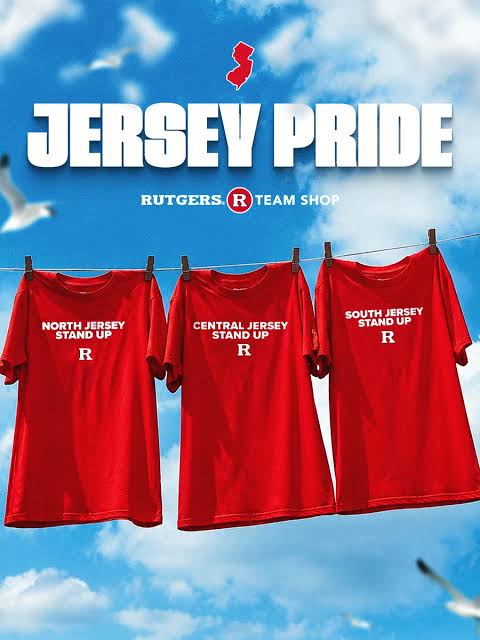
Rutgers lost to USC on Saturday. Central Jersey won merch.
The football result was 42-35, USC. The attendance was 43,045. Those are both real numbers and, depending on your priorities, may even be the important ones. But Rutgers University managed to stage a much more New Jersey argument around the game without calling it an argument at all.
For its Sept. 19 matchup at SHI Stadium in Piscataway, Rutgers designated the day "New Jersey Day" and sold three different regional shirts: North Jersey, Central Jersey and South Jersey. Fans could buy the version corresponding to the part of the state they believe they inhabit, then spend the afternoon wearing their geographic testimony on their chest.
This is an inspired solution to one of New Jersey's most durable identity disputes because Rutgers did not attempt to settle it. Rutgers merchandised it.
There is a shirt for North Jersey. There is a shirt for South Jersey. And, most importantly for the people who have spent decades being told they live in a region invented by real-estate agents, weak cartographers or people afraid to choose sides, there is a shirt for Central Jersey.
Officially enough to print. Officially enough to sell. Officially enough that somewhere in the stadium on Saturday, a person could point at their own torso and say, "See?"
Rutgers did not settle the North/Central/South Jersey argument. It turned the argument into inventory. The funny part is that Central Jersey technically did not need Rutgers to validate it. New Jersey did that itself three years ago.
In August 2023, the state enacted a law requiring the Division of Travel and Tourism to redraw New Jersey's tourism map to create a "Central Jersey" region. The law specified that the region include, at minimum, Hunterdon, Mercer, Middlesex and Somerset counties and required the state to incorporate Central Jersey into its marketing. In the narrow administrative sense, the argument was over.
In the actual New Jersey sense, of course, the argument continued immediately. That is because nobody has ever really been fighting about whether the words Central Jersey can appear on government stationery. The fight is about belonging. It is about whether a place feels pulled toward New York or Philadelphia, whether the shore means one set of towns or another, which sports teams dominate the television, what people call the breakfast meat, what radio stations were in the car growing up and how long someone is willing to argue that a county is "basically North Jersey" before another person begins gesturing at a map.
Administrative borders can identify counties. They cannot tell people what a place feels like. That is why the Rutgers shirt is oddly more interesting than the statute. The law tells New Jersey that Central Jersey exists for tourism purposes. The shirt asks a fan to choose it as an identity. One is a classification. The other is a declaration.
New Jersey is only about 170 miles from top to bottom, which should make regional identity fairly straightforward. Instead, the state has managed to compress the territorial instincts of a continent into a drive you can complete before dinner.
North, Central and South Jersey are useful because they are not merely compass directions. They are bundles of assumptions. They describe commuting patterns, media markets, accents, sports allegiances, shore habits, highway vocabulary, food arguments and the invisible gravitational pull of two major cities sitting just outside the state. A person can tell you where they live and another New Jerseyan will immediately begin translating that location into a cultural map.
That cultural map is why the borders remain gloriously unstable. Middlesex can feel indisputably central until someone from Bergen arrives. Monmouth can be Central Jersey in one conversation and the northern edge of the Shore in another. Ocean County can trigger a regional argument before anyone has finished naming the town. Union County can produce a committee hearing at a backyard barbecue.
None of this requires the categories to be scientifically precise. In fact, precision would ruin some of the fun. Regional identity works because it gives people a shorthand for describing not just where they are, but what kind of New Jersey they think they understand.
The genius of the Rutgers promotion was recognizing that a T-shirt does not require a border commission. It only requires a customer willing to pick one.
Merchandise is particularly good at this because clothing turns an argument into a badge. A map can tell you what somebody else decided. A shirt tells the room what you decided.
That is already how sports apparel works. The hat is not merely a hat; it is an allegiance. The old concert shirt is not merely cotton; it is evidence that you were there, or at least that you want everyone to know which era of the band you consider legitimate. A local diner shirt, shore-town hoodie or minor-league giveaway can function as a portable biography.
Rutgers simply applied that logic to New Jersey geography. Pick North. Pick Central. Pick South. Then walk into the stadium among 43,000 other people who may have a completely different theory about where your region ends.
The school even has a uniquely credible claim to the middle of the argument. Rutgers' flagship campus is spread across New Brunswick and Piscataway in Middlesex County, one of the counties specifically named in the 2023 Central Jersey law. If any major New Jersey institution was going to put Central Jersey on a shirt without asking permission from the comment section first, Rutgers had jurisdictional standing.
And the shirts do something that official designations rarely accomplish: they make the disagreement fun. Nobody needs a white paper explaining the socioeconomic distinctions among New Jersey's regions. You just need three tables of merchandise and several thousand people prepared to take the bait.
This may be the best possible fate for the Central Jersey debate. New Jersey has already tried legislation. It has tourism maps. It has official language. None of that was ever going to stop the argument because stopping the argument misunderstands the point of the argument.
People do not debate Central Jersey because the state desperately requires a universally accepted regional taxonomy. They debate it because New Jerseyans enjoy locating themselves in relation to one another. Geography becomes personality. A county line becomes evidence. A breakfast sandwich becomes a loyalty test. Somebody says "there is no Central Jersey" and half the room immediately develops a closing statement.
Rutgers understood the assignment. Do not convene a panel. Do not publish another map. Print three shirts and let everybody self-report.
So, yes: Rutgers put Central Jersey on a T-shirt. Argument over?
Please. This is New Jersey. The shirt is not the verdict. The shirt is exhibit A.
SOURCE NOTES
• Rutgers New Jersey Day announcement: Rutgers Athletics, Game 3: Football vs. No. 12 USC (Sept. 14, 2026). Rutgers announced that North, Central and South Jersey shirts would be sold inside SHI Stadium and on the Rutgers Boardwalk as part of New Jersey Day.
• Game result and attendance: Rutgers Athletics, Football Loses to No. 11 USC (Sept. 19, 2026). Final: USC 42, Rutgers 35; attendance 43,045.
• Central Jersey statute: New Jersey P.L. 2023, Chapter 149. The law requires the Division of Travel and Tourism to create a Central Jersey tourism region including, at minimum, Hunterdon, Mercer, Middlesex and Somerset counties.
Game details attributed to Rutgers Athletics; Central Jersey region to P.L. 2023, Chapter 149, cited in SOURCE NOTES. Cultural framing is RMN's.